March 19, 2026
Cost-Effective Recruiting Strategies for Small Businesses
Hiring the right people shouldn’t drain your budget dry. For small businesses, finding skilled talent without overspending may feel quite challenging. We know that large corporations have the advantage of bigger recruitment budgets, while small companies don’t really have that luxury. But the truth is that smart, cost-effective recruiting strategies consistently outperform expensive ones. The secret lies in building a deliberate hiring process that stretches every dollar further. From leveraging employee referral programs to tapping into affordable online job portals, the right moves can dramatically reduce your cost per hire.
This guide walks you through exactly what works in 2026 – practical, proven, and built specifically for lean teams ready to hire smarter.
Every dollar wasted on hiring is a dollar pulled out from a company’s growth potential. The cost per hire has climbed steadily over the past few years. Inflation, remote work expectations, and a more selective workforce have made the hiring process tougher for small businesses. As per the U.S. Department of Labor, the cost of a bad hire is about 30% of the employee’s first-year earnings, which is a substantial cost for any business.
Cost-effective recruiting strategies or an effective talent acquisition strategy for small businesses aren’t just about saving money. They’re about making smarter hiring decisions that stick. When you reduce waste in your recruitment funnel, you improve speed, quality, and retention rate all at once. That’s the compounding effect most small business owners overlook.
Imagine losing your only sales rep within three months of hiring. For a 10-person team, this one gap can disrupt everything. The recruitment costs pile up fast. Job ads, agency fees, lost productivity, and onboarding time.
A large corporation barely flinches, but a small business feels it has been hit hard on its revenue. Recruitment ROI matters more at a smaller scale. Every hire is high stakes. This is why building a deliberate, budget-smart talent acquisition system isn’t optional in 2026. It’s survival.
Given below are some cost-effective recruitment strategies that small businesses can follow to ensure that hiring is done right from the beginning.
Most small business job ads fail before a single person applies. Why? Vague titles like “Marketing Ninja Needed” confuse job seekers. If an opportunity announcement has no salary range, top candidates may skip applying for the position entirely. And if your job opportunity announcement is visually unattractive, chances are applicants will skip past it within the first three seconds. Job postings are your first impression, and most businesses treat them like an afterthought. But the fix is simpler than you think.
Use clear, searchable job titles that match what people actually type into Indeed or LinkedIn. Add a salary range as it is now legally required in several US states, including California, New York, and Colorado. Keep your candidate experience positive from the very first line. According to LinkedIn, job posts with salary ranges get 30% more applications.
Your job description is a sales pitch. You’re selling the role to the right person. Lead with what makes your company worth joining. Then clearly list responsibilities, requirements, and compensation. Keep paragraphs short. Use plain language and avoid jargon.
Optimize your job title for Google for Jobs – it’s free and powerful. An applicant tracking system like Breezy HR or Workable helps you manage applications without chaos. Even a free plan gives you a structured hiring funnel that saves hours every week.
Referrals are the most cost-effective channel in recruiting. As per research conducted by recruiting software platform Jobvite, referred hires stay 45% longer and onboard faster as compared to those hired through career sites. Your current team already knows your culture. They’ll only refer people they’d want to work with. That’s a built-in cultural fit assessment happening before the first interview.
A simple employee referral program doesn’t need to be expensive. Offer a $200 to $500 bonus paid after the new hire completes 90 days. That’s still far cheaper than agency fees. Reduce hiring costs while improving hire quality at the same time. It’s one of the best cost-per-hire reduction strategies available to small teams.
Structure your referral program in three tiers. First, a small thank-you gesture when the referral gets an interview. Second, a mid-tier bonus at the time of hire. Third, the full reward after 90 days of employment. This protects your budget while keeping employees engaged throughout the process.
Tools like ReferralHero or even a simple Google Form can work perfectly. Don’t overcomplicate it. Workforce productivity improves when employees feel invested in who joins the team. Hiring costs drop significantly when referrals fill even 30% of your open roles.
A talent pipeline is your roster of warm candidates. This includes people who’ve applied before, attended your events, or connected with your team on LinkedIn. Most small businesses delete old applications and start from zero every time. That’s expensive and unnecessary.
Internal mobility is equally powerful. Before posting externally, ask if there is someone already on the team ready to step up? Promotions are faster, cheaper, and boost morale. SHRM states that talent pooling combined with internal promotions can cut your external recruitment costs by up to 40% annually.
Start with a simple spreadsheet. Track every strong candidate who didn’t get hired but impressed you. Note their skills, the role they applied for, and when to follow up. Send a brief LinkedIn message or email every quarter. Keep the relationship warm.
Candidate sourcing from your existing network costs nothing. Former interns, freelancers, and even candidates from past recruitment funnel stages are gold. Building this habit takes two hours a month and pays dividends when you need to hire fast.
Slow screening burns money. With each passing day that a role stays vacant, productivity dips, and existing staff are stretched thin. An applicant tracking system fixes this immediately. It automates resume sorting, sends follow-up emails, and keeps every candidate stage visible in one dashboard.
For cost-effective recruiting strategies for small businesses, tools like Zoho Recruit, Workable, and Breezy HR offer free or low-cost plans. Recruitment analytics built into these tools show you where candidates drop off, what sources perform best, and how to improve. There’s no denying that data-driven hiring decisions replace guesswork entirely.
Here’s a quick comparison of tools that fit small business budgets:
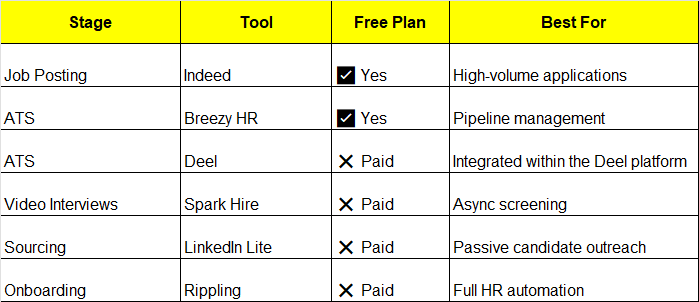
Resume parsing tools inside most ATS platforms cut manual screening time by 60%. Skills gap analysis features help you hire for growth, not just today’s needs. Ensure that you invest in one good tool. It pays for itself within the first hire.
An Upwork study reveals that 59 million people performed freelance work in 2021. This substantial number represents about 36% of the entire U.S. workforce. The gig economy isn’t a trend. It’s the new normal. For small businesses, this is a massive opportunity. You can hire skilled professionals for specific short or long-term projects.
Freelancers and gig workers shine in areas like content creation, web development, bookkeeping, and design. Platforms like Upwork, Toptal, and Contra connect you with vetted talent fast. Remote job openings widen your talent pool beyond your zip code. Flexible work arrangements also attract high-caliber candidates who prioritize work-life balance over a corner office.
The IRS has strict rules about worker classification. Misclassifying an employee as a contractor can result in heavy fines. Know the difference before you hire. Contractors control how they work and typically use their own tools. Employees follow your direction and schedule.
The savings are real with contractors – no payroll taxes, no benefits, no PTO. Workforce flexibility is the biggest advantage. But for ongoing, core roles, a part-time employee often makes more sense. Cost per hire drops when you match the engagement model to the actual need.
Not all agencies are created equal. Contingency agencies only charge when you hire, typically 15% to 25% of the first-year salary. Retained agencies charge upfront. For small businesses, contingency models carry far less financial risk. You only pay for results.
Talent acquisition on a budget gets easier when you negotiate. Most small businesses don’t realize agency fees are negotiable. Ask for a replacement guarantee of at least 90 days. Request a reduced fee for multiple hires. A good recruitment agency becomes a genuine partner, not just a vendor. They understand your culture, speed up candidate sourcing, and improve hiring decisions dramatically.
Always ask about their specialization. A generalist agency filling roles across every industry rarely performs as well as a niche firm. Ask about their average time to fill positions. Ask what happens if the hire leaves in 60 days. These questions reveal everything about their process and accountability.
Also, ask how they handle passive candidate outreach. The best agencies can reach candidates who are not actively looking for opportunities. That’s where top talent often hides. A strong hiring process built with the right agency partner can transform your recruiting results without blowing your budget.
According to Glassdoor, 75% of candidates research a company before applying. Your reputation as an employer is either working for you or against you, even before you post a job. A strong employer branding strategy is the gift that keeps giving. It reduces paid advertising spending and brings candidates directly to your door.
Employer branding strategies for talent attraction don’t require a marketing agency. Start with your Glassdoor and LinkedIn company profiles. Respond to every review – positive and negative. Share team stories, behind-the-scenes moments, and company wins on social media. Candidate experience starts the moment someone Googles your business name. Make sure what they find makes them want to work for you.
Ask your happiest employees to leave honest Glassdoor reviews. Feature team members on LinkedIn. Share “A day in the life of an employee” posts regularly. These small actions build employer reputation consistently over time. Employee engagement rises when staff feel proud to represent their company publicly.
A simple three-step content plan works well. This can include:
Workforce productivity correlates directly with how valued employees feel. When your brand reflects that value externally, great candidates notice fast.
Campus hiring and internship programs let you evaluate potential full-time hires at low cost before committing to a salary. According to NACE, 70% of interns who receive a job offer accept it. The benefits of hiring fresh graduates and interns go beyond cost savings. They bring fresh ideas, digital fluency, and high energy. They’re also highly trainable. Skills gap analysis at the point of hiring helps you identify exactly where a few weeks of onboarding can bridge the gap. Use Handshake or WayUp to connect with US college talent for free.
Structure your internship around real work, not busy work. Assign a mentor. Set clear goals for the 10 to 12-week period. Give interns ownership of one meaningful project. This training and upskilling experience builds loyalty fast.
Pay fairly, at least the minimum wage, or ideally more. Employee retention starts at the internship stage. A well-run program creates a pipeline of pre-vetted, culture-aligned candidates ready to join full-time. That’s talent acquisition at its best.
You can’t improve what you don’t measure. How to use recruitment analytics for better hiring starts with five core KPIs: cost per hire, time to fill positions, offer acceptance rate, 90-day retention rate, and quality of hire. Track these analytics monthly. Remember, patterns emerge fast.
Recruitment analytics inside your ATS will surface most of this data automatically. If you’re not using an ATS yet, a simple Google Sheets dashboard works fine. Data-driven hiring decisions replace gut feelings with real evidence. This is how cost-effective recruiting strategies for small businesses become a competitive advantage and not just a cost-saving measure.
Your dashboard needs five columns:
Review your dashboard every two weeks. Look for bottlenecks. If candidates consistently drop off after the first interview, then perhaps you need to fix the interview experience. If the time to fill positions is high for one role type, review your job ad or sourcing channel.
The cost per hire should trend downward over time as your systems improve. Your hiring funnel data will tell you exactly where to focus your energy. We reiterate: Whatever gets measured gets improved. And eventually, processes that are improved time and again help businesses save real money.
Small businesses don’t need enterprise budgets to build winning teams. You need smarter systems, better relationships, and a clear strategy. From optimizing job postings to building a strong employee referral program. From tapping the gig economy to strengthening your employer branding – every strategy in this guide is actionable today.
Pick one and start now. Even a single referral program or a refined job description can drastically reduce your next hire’s cost. Cost-effective recruiting strategies for small businesses aren’t about doing less; they’re about doing the right things, in the right order, with intention.
Employee referral programs consistently deliver the lowest cost-per-hire, with referred candidates onboarding faster, fitting the culture better, and staying significantly longer than other hires.
The 5 C’s are Competency, Character, Culture fit, Compensation, and Commitment. These are the five core factors every hiring decision should evaluate before extending an offer.
The 70/30 rule suggests hiring candidates who meet 70% of the job requirements today, trusting that the remaining 30% of skills can be developed through training and upskilling on the job.
The five core strategies are employee referrals, internal mobility, social media recruitment, campus hiring, and partnering with recruitment agencies. Each serves a different hiring need and budget level.
The 4 P’s are Position, People, Process, and Performance. This is a framework that helps businesses define the role clearly, target the right candidates, streamline hiring steps, and measure long-term hiring success.