March 17, 2026
How Start-Ups Can Build a Talent Acquisition Strategy from Scratch

Building a talent acquisition strategy for startups from scratch can feel overwhelming, but it doesn’t have to be. Most early-stage companies make the same mistake: they hire reactively, filling seats as panic sets in, rather than building a deliberate system. This approach brings in higher costs, damages company culture, and stalls business growth.
The truth is that your people are your most powerful competitive advantage. A smart startup hiring strategy helps you find the right talent before you desperately need them. It aligns every hire to your business goals, strengthens your employer branding for startups, and builds a scalable talent acquisition engine that grows with you.
Through this guide, we will help you understand the fundamentals of talent acquisition and show you how to build a smart system from scratch.
Talent acquisition is not just hiring. It’s a long-term, strategic approach to finding, attracting, and retaining the right people for your company’s future. While recruitment fills today’s empty seats, a talent acquisition strategy aims at building a steady workforce for years to come.
As a startup, you may face a uniquely brutal challenge here. You’re competing against tech giants and other multinationals with huge budgets, established cultures, and brand recognition that you haven’t earned yet. You know that your employer’s value proposition has to work harder to prove itself. You also know that speed, agility, and authenticity are your real advantages. And having a smart startup hiring strategy turns these advantages into a successful system that scales.
We now know that recruitment is reactive. A role opens up, you post a job, and you hire someone. Strategic hiring, on the other hand, means you’re always thinking ahead. You’re building relationships with candidates before you need them, nurturing a talent pipeline, and aligning every hire to a business goal. For startups, moving toward this hiring shift early on is essential.

The key is to start with your business goals and not job titles. Ask yourself where your company needs to be in, let’s say, 6, 12, and 24 months. Work backwards from that vision to understand which roles are mission-critical versus the ones that are simply nice-to-have. Your hiring roadmap should mirror your product and revenue roadmap. This is how great founders think about people: as strategic investments and not operational costs.
The building process of a successful talent acquisition strategy isn’t extremely complicated, but it does require discipline. Regularly, audit your gaps, define your roles, set your metrics, choose your tools, activate your sourcing, then iterate. Remember, a solid, scalable hiring process isn’t built once and forgotten. It evolves constantly (ideally every quarter) as your startup grows.
Given below are proven steps to help you build your talent acquisition strategies from scratch.
Before you build anything, assess what you actually have. Do you have internal HR capabilities, or are founders doing all the hiring themselves? What’s working? What processes seem to be broken? This audit tells you exactly where to invest first and what gaps your talent acquisition partnerships need to fill.
Not all roles are equal. Some will directly drive revenue. Others support the team. Use job architecture to rank your open roles by impact and urgency. For example, a SaaS startup scaling its product needs a backend engineer before it needs an office manager. Prioritize with purpose, not panic.
Define success before you start. Know your target time-to-hire, cost-per-hire, and quality of hire benchmarks upfront. These hiring KPIs become your north star. They also protect you from vanity metrics like application volume that feel good but tell you nothing useful.
Your recruiting tech stack doesn’t need to be expensive. An Applicant Tracking System (ATS) combined with LinkedIn Recruiter and a few niche job boards gets most startups 80% of the way there. Don’t over-engineer this. Start lean, adding tools as your business needs grow.
Your strategy on day one won’t be your strategy on day 180. Build in quarterly reviews. Gather hiring manager feedback after every hire. Ask candidates about their experience. The startups that win at talent aren’t the ones with the most sophisticated systems; in fact, they are the ones that work on continuously improving.
The strategies below are built specifically for lean teams operating with tight budgets and ambitious growth targets. A strong startup talent strategy blends brand, technology, culture, and partnerships into one cohesive system. Each element reinforces the other.
From employer branding and referral programs to talent acquisition partnerships and structured interviewing, these ten strategies work across every stage.
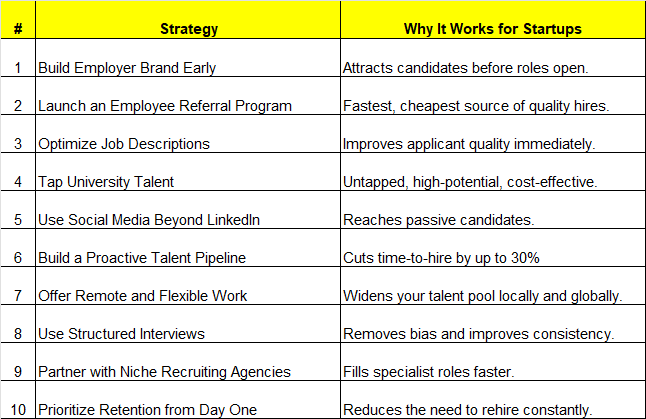
Here’s a fact that will change your views about hiring. According to a LinkedIn survey, 50% cost-per-hire savings is associated with a strong employer branding for startups.
So, the point is that you don’t need a huge marketing budget to build a powerful brand. What you need is authenticity, consistency, and a compelling story about where you’re going and why it matters.
Your careers page is your silent recruiter. It works 24/7. Most startups neglect it completely, and that’s a costly mistake. Reveal your company culture through real photos, honest team stories, and clear values. Highlight growth opportunities. Tell candidates exactly what working with your team feels like. Authenticity takes first place every single time.
Your careers page should answer every question a top candidate is silently asking. Include your mission, your culture, your benefits, and your team’s growth stories. Add photos of real people doing real work. Careers page optimization isn’t about design; it’s about building trust. Make candidates feel like they belong even before they apply.
Employee advocacy is your most credible recruiting asset. A founder’s pitch sounds like a pitch. But a real engineer talking about why they love their job, that’s gold! Encourage your team to share their experiences on LinkedIn and Glassdoor. Genuine voices build more trust than any job ad you’ll ever write.
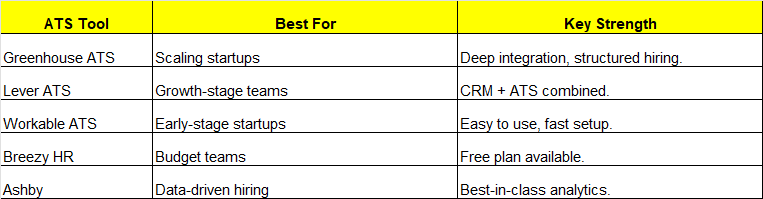
An Applicant Tracking System (ATS) isn’t just an organizational tool; it’s a force multiplier for small teams. Platforms like Greenhouse ATS, Lever ATS, and Workable ATS centralize applications, automate scheduling, track candidate progress, and generate the performance metrics hiring teams need to improve. Without one, you’re managing hiring in spreadsheets and email chains. This approach is slow, time-consuming, and can break fast.
Stop with the job posting and praying approach. Instead, start building your talent pipeline before a role even opens. Proactive sourcing means you’re always having conversations, always building relationships, always nurturing warm candidates. This single shift cuts time-to-hire by up to 30%, according to internal analysis from multiple talent acquisition platforms.
The best candidates aren’t often on job boards. They’re in Slack communities, GitHub repos, niche forums, and industry newsletters. Passive candidate sourcing means going where they already are. Use LinkedIn Recruiter, GitHub, Dribbble, and community platforms to reach people who aren’t actively looking but might be open to the right conversation.
Candidate relationship management with silver medalists, i.e., candidates who nearly got the job previously, is one of the most underused strategies in startup hiring. These people already know your company, respect your process, and have come close once before. When a new role opens, they’re your warmest possible leads. Keep them engaged with company updates and personal check-ins.
Strategic recruiting partnerships come in several forms. Retained search firms are ideal for executive and senior roles where precision matters more than speed. Contingency agencies work well for volume hiring with faster turnaround. Freelance recruiters offer flexibility and cost-effectiveness for specific or short-term needs. RPO providers take over your full startup recruitment process when you need to scale fast without building an internal team.
Recruiter onboarding is where most startups drop the ball. Don’t just send over a job description and hope for the best. Share your culture deck, give ATS access, walk partners through your interview stages, and set a regular feedback cadence. The more context your specialized recruiters have, the faster and more accurately they’ll source for you.
According to Glassdoor, 76% of job seekers consider workplace diversity a key deciding factor when evaluating offers. Diversity hiring isn’t just the right thing to do; it’s a direct competitive advantage in today’s talent market. Startups that embed inclusive recruiting early on attract broader, stronger, and more innovative candidate pools than those that treat DEI as an afterthought.
Culture-driven hiring means evaluating for culture-addition rather than culture-fit. Culture-fit can quietly reinforce homogeneity. Culture addition brings in people who share your values and contribute new perspectives. Use values-based job descriptions, diverse interview panels, and structured scorecards to eliminate unconscious bias from your candidate screening process.
Inclusive job postings start with simple language. Remove unnecessary jargon, avoid masculine-coded words like “rockstar” or “ninja,” and use tools like Textio to audit your copy. Keep requirements honest. Don’t list ten “must-haves” when you really need four. Equity in recruitment means lowering artificial barriers so the best person for the role can actually find you.
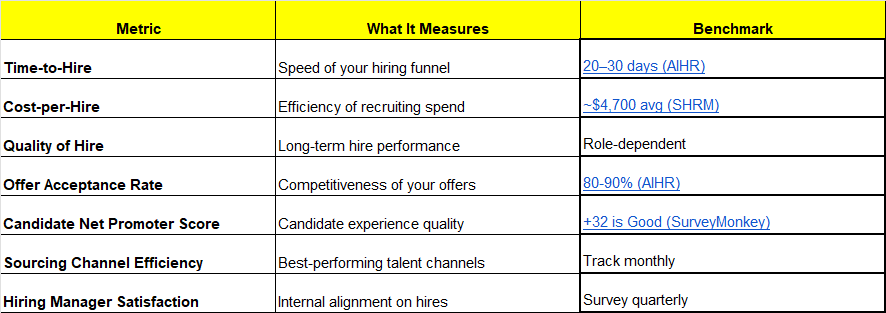
You can’t improve what you don’t measure. Talent acquisition metrics turn gut-feel hiring into a repeatable, data-driven system. Set up your recruiting dashboard from day one, and not after you’ve made your first twenty hires. Recruiting analytics reveal where your funnel leaks, which channels perform best, and where candidates are dropping off.
Focus on leading indicators alongside lagging ones. Here are some indicators that can help you keep score and measure performance. Sourcing channel efficiency tells you where your best hires come from. Candidate net promoter scores tell you how candidates feel about your process. Offer acceptance rate reveals whether your compensation and culture are competitive. Quality of hire tells you whether the people you’re bringing in are actually performing.
Hiring too fast without a defined process is the single most common and most damaging mistake in the startup recruitment process. Reactive hiring fills seats. It doesn’t build teams. The pressure to move quickly can push founders into skipping steps, ignoring red flags, and prioritizing speed over fit. That’s a pattern that costs far more to fix than it costs to avoid. A smart talent acquisition strategy protects you from this trap.
Startup hiring mistakes compound fast. One bad cultural hire brings team tension, one wrong technical hire slows your product, and one missed DEI opportunity costs you in talent diversity for years. Recruiter accountability and a clear hiring process audit after every hire are bound to keep your strategy sharp and your team strong.
The best startups treat talent as a product. They build a hiring roadmap, set talent acquisition KPIs, run structured retrospectives, and iterate relentlessly. Notion’s talent strategy, for example, combined internal recruiting with niche external partnerships to build a world-class product and design team at remarkable speed. They didn’t just fill roles; they built a system.
How start-ups can build a talent acquisition strategy from scratch isn’t a mystery; it’s a process. Start with your business goals. Define your roles with precision. Build your employer brand before you need it. Use technology to multiply your team’s output. Partner strategically. Measure everything. And never stop iterating.
The startups that win the talent game aren’t always the ones with the biggest budgets. They’re the ones that think strategically, move intentionally, and treat every hire as a long-term investment. Start your audit today. Your next great hire is already out there. You just need to make sure that you’re ready to find them.
Start by aligning your hiring goals to business objectives, then defining key roles, setting measurable KPIs, choosing your sourcing channels, and building a repeatable recruiting workflow that improves every quarter.
The 5 Cs are Competency, Character, Communication, Culture-fit, and Commitment. These are the five core qualities every strong hire should demonstrate before they get an offer.
80% of your best hires will come from just 20% of your sourcing channels, so identify what’s working fast and double down on those channels relentlessly.
The 4 Ps are People, Process, Pipeline, and Performance. These are the four pillars that determine whether your startup’s recruitment process attracts top talent or consistently misses the mark.
Never hire out of desperation. Always hire ahead of need, because a rushed hire made under pressure almost always costs more to fix than the vacancy ever did.